


Structural Steel Framework
A commercial building is only as reliable as the frame carrying its loads. Before walls, roofing, cladding, services, and interiors are added, the steel framework sets the strength, shape, and long-term safety of the project.
In structural fabrication, that framework is not just a collection of beams and columns. It is a planned, measured, cut, welded, inspected, finished, and installed system. Every connection matters. Every hole position matters. Every weld and bearing point affects how the structure performs once the building is in use.
For commercial projects such as warehouses, retail spaces, workshops, showrooms, production facilities, and multi-storey developments, structural steel offers a strong balance of load capacity, accuracy, durability, and installation speed. When fabricated correctly, it helps contractors build with confidence and gives owners a dependable structure designed for years of service.
Project planning starts with the building purpose
Strong structural fabrication begins before any steel is cut. The first stage is understanding what the building must support and how it will be used.
A commercial structure may need open floor space, high roof clearance, heavy equipment support, mezzanine levels, loading bays, crane rails, service platforms, or wide entrances. Each requirement affects the steel frame design.
During planning, the fabrication team reviews drawings, site conditions, connection details, and installation requirements. The goal is to identify practical fabrication routes before work enters the shop floor.
Key planning considerations include:
Building span and height
Column grid and beam layout
Dead loads and live loads
Wind exposure and lateral stability
Roof and wall cladding support
Service openings and access points
Connection types and bolt sizes
Transport limits for fabricated sections
Erection sequence at site
Safety access during installation
This early review helps reduce delays during fabrication and installation. It also allows the team to find issues that may not be obvious on drawings, such as difficult-to-reach welds, tight bolt access, lifting limitations, or member clashes.
Good planning gives the project a cleaner path from engineering design to finished steelwork.
Steel selection affects strength, durability, and fabrication quality
The performance of a structural steel framework depends heavily on selecting the right steel sections and grades. Commercial projects often use rolled steel beams, columns, channels, hollow sections, plates, and angles. Each section has a role in carrying loads and transferring forces through the frame.
Steel selection must match the engineering design, but it also needs to suit fabrication and site handling. A section may be strong enough on paper, yet difficult to weld, lift, transport, or connect if practical details are ignored.
A professional fabrication team checks:
Section size and grade
Plate thickness
Straightness and surface condition
Mill certificates where required
Compatibility with welding procedures
Suitability for galvanising, painting, or other finishes
Availability from reliable steel suppliers
For commercial structures in Pakistan and similar conditions, durability is a major concern. Steelwork may face heat, dust, humidity, rain, industrial fumes, or coastal air depending on the site. Selecting the right protection system is part of the structural decision, not an afterthought.
The best result comes from steel that meets the required strength while allowing accurate fabrication, safe installation, and dependable long-term performance.
Accurate measurements create a frame that fits on site
Structural steel fabrication is unforgiving. A small error in measurement can cause bolt holes to misalign, beams to sit incorrectly, or columns to shift out of plumb. That is why measurement control is one of the most important parts of the workshop process.
Before cutting begins, fabricators study shop drawings and confirm member lengths, hole positions, end cuts, plate sizes, connection locations, and weld requirements. Marking is carried out with care so each component matches the approved layout.
Accurate measurement supports:
Proper beam-to-column connections
Correct base plate positioning
Reliable bolt alignment
Consistent floor and roof levels
Reduced site rework
Faster erection
Better overall structural behaviour
For large commercial frameworks, the team may use templates, jigs, calibrated measuring tools, and controlled marking systems to maintain repeatability across similar parts. When several beams or columns share the same detail, consistency becomes vital.
Measurement accuracy also protects the installation schedule. Steel that arrives on site ready to fit saves crane time, labour hours, and costly adjustments.
Cutting and drilling prepare each member for assembly
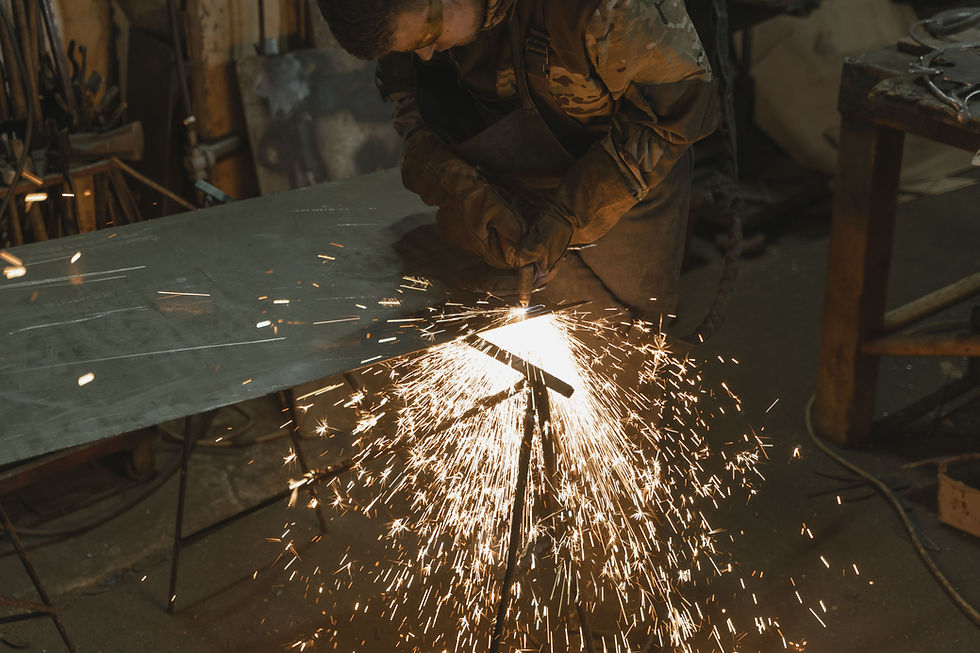
Once measurements are confirmed, the steel is cut to size. Cutting may involve saw cutting, gas cutting, plasma cutting, shearing, or other workshop methods depending on the material type, thickness, and required finish.
The aim is not only to cut the steel to length. The cut must be clean, controlled, and suitable for welding or bolting. Poor cuts can create fit-up issues, uneven bearing, weak weld preparation, or an untidy finished structure.
After cutting, holes are drilled or punched as specified. Bolt holes must be placed with accuracy so connections align during workshop assembly and site installation.
Fabricators also prepare:
Mitred ends where members meet at angles
Coping on beams for connection clearance
Slots or openings for service coordination
Base plate holes for anchor bolts
Gusset plates and stiffeners
Brackets, cleats, and connection plates
Edge preparation is completed where welded joints require bevels or clean contact surfaces. Burrs, slag, and sharp edges are removed to improve fit-up and reduce handling hazards.
This stage turns raw steel into identifiable project components. Each piece must match the drawing because the frame depends on every member working as part of a connected system.
Welding turns individual parts into structural assemblies
Welding is where skill and control become highly visible. A commercial steel frame relies on welded connections such as base plates, end plates, stiffeners, cleats, brackets, truss joints, and built-up members.
A good weld must do more than look neat. It must provide the required strength, fusion, and continuity. The welding process should match the steel grade, joint type, thickness, and project specification.
Before welding, fabricators check joint fit-up. Gaps, alignment, edge preparation, and restraint all affect weld quality. Tack welds hold the parts in place before full welding begins. The team controls distortion by using suitable welding sequences, balanced heat input, and proper clamping.
Professional welding focuses on:
Correct weld size
Proper penetration where required
Controlled heat input
Clean weld surfaces
Minimal distortion
Strong fusion between parts
Consistent workmanship across similar joints
Welders also clean surfaces before welding to remove rust, paint, oil, moisture, and other contaminants. A clean weld zone supports better fusion and lowers the chance of defects.
In structural fabrication, dependable welding is not optional. It is one of the main reasons steel can carry heavy loads while maintaining stable connections throughout the building.
Trial assembly improves installation confidence
For complex commercial frameworks, selected components may be trial assembled in the workshop. This is especially useful for trusses, portal frames, stair supports, mezzanine structures, large gantries, and repeat connection assemblies.
Trial assembly helps confirm that fabricated members fit as intended before they are transported to site. It gives the team a chance to check bolt alignment, plate contact, member orientation, and connection clearances.
The benefits are practical:
Fewer surprises during erection
Better control over connection fit
Reduced site modification
Safer installation work
Faster placement of steel members
Clearer identification of each part
Assemblies are usually marked and tagged before dispatch. Clear part identification helps the installation crew follow the erection sequence and place each member in its correct location.
For commercial construction, where multiple trades may be working around the same schedule, this level of preparation helps keep work moving with less conflict on site.
Quality checks protect the structure before it reaches site
Quality control is built into every stage of structural steelwork. A fabrication company cannot rely on final inspection alone. Checks must happen during material receiving, marking, cutting, welding, assembly, finishing, and dispatch.
Common quality checks include:
Verifying steel sections against drawings
Checking member length and dimensions
Inspecting hole locations and diameters
Reviewing weld size and appearance
Checking for distortion or misalignment
Confirming plate orientation and connection details
Inspecting surface preparation before finishing
Ensuring components are marked correctly
Where the project requires it, welds may also be checked using non-destructive testing methods. These can help identify hidden defects without damaging the member.
Dimensional inspection is equally important. Even strong welds and good steel cannot correct a frame that has been fabricated out of line. Straightness, squareness, and correct connection geometry all contribute to final performance.
Quality checks show whether the fabricated steel matches the design intent and is ready for safe installation. They also reflect the fabrication company’s commitment to dependable craftsmanship.
Finishing protects the steel and improves service life
After fabrication and inspection, the steelwork is prepared for finishing. Surface preparation may include grinding, cleaning, degreasing, wire brushing, blasting, or other methods suited to the project specifications.
The finish protects the steel from corrosion and site exposure. It may also improve appearance where the steel remains visible in the finished building.
Common finishing systems include:
Primer and paint systems
Epoxy coatings
Hot-dip galvanising
Fire protection coatings where specified
Touch-up paint for site-welded or damaged areas
The correct finish depends on the building use and environment. An indoor retail space may need a different coating system from a warehouse near humid or industrial conditions. A coastal or high-moisture site may call for stronger corrosion protection.
Finishing should not cover poor workmanship. Weld spatter, sharp edges, surface defects, and contamination need attention before coating. Good surface preparation helps coatings bond properly and perform for longer.
A well-finished steel frame looks professional, resists corrosion, and supports the long-term value of the commercial project.
Installation brings the fabricated framework into position
Site installation is the point where planning, fabrication accuracy, and safety control come together. The steel arrives in marked sections and is erected according to the approved sequence.
Before installation begins, the crew checks foundations, anchor bolt positions, access routes, lifting points, and site conditions. Base plates must sit correctly, columns must align with anchor bolts, and bearing surfaces must be prepared.
The installation process usually includes:
Setting out grid lines and member positions
Lifting columns into place
Securing base plates and temporary supports
Installing beams and bracing members
Aligning and plumbing the frame
Tightening bolts to specification
Completing site welding where required
Checking final line, level, and stability
Safety is central throughout the work. Steel members are heavy, and commercial sites often involve cranes, lifting gear, scaffolding, elevated work, and nearby trades. Installation teams must use the right equipment, certified lifting methods, and controlled work zones.
Accurate fabrication makes installation safer. When members fit properly, crews spend less time adjusting steel at height. That reduces risk and helps keep the site organised.
Final performance depends on the whole fabrication process
A completed structural steel frame must do more than stand in place. It must carry loads safely, maintain alignment, support other building systems, and perform under normal building movement, wind forces, and daily use.
The final performance of the frame depends on many linked decisions:
The design must suit the building use.
The steel must meet the required strength.
Measurements must be accurate.
Cuts and holes must match the drawings.
Welds must be strong and clean.
Assembly must confirm fit.
Coatings must protect the surface.
Installation must place the frame correctly.
When each step is handled with care, the finished framework supports heavier loads, wider spans, cleaner layouts, and safer construction. It also gives architects, contractors, and owners more flexibility in how the commercial space is used.
A well-fabricated steel frame can make room for open interiors, tall storage areas, heavy equipment, service platforms, signage supports, loading canopies, and future changes. That makes structural steel a practical choice for many commercial projects across Pakistan.
Why commercial projects depend on skilled structural fabrication
Commercial buildings often run on tight schedules. Delays in the structural frame can affect roofing, cladding, electrical work, mechanical services, flooring, and interior fit-out. Skilled fabrication helps prevent those delays by delivering steel that is accurate, clearly marked, and ready for erection.
Good structural fabrication also improves safety. A properly fabricated frame reduces forced fitting, rushed site welding, unstable temporary conditions, and repeated lifting corrections. Every accurate member helps the site team work with more control.
The value of professional fabrication shows in details that may not be noticed at first glance:
Clean connection plates
Straight columns
Smooth weld profiles
Correct bolt alignment
Durable coatings
Clear member marking
Careful handling and loading
Consistent finish quality
These details create a structure that performs well and reflects professional workmanship. For a commercial metal fabrication company, that is where trust is built.
A stronger frame starts in the fabrication shop
Structural steel frameworks support commercial projects because they combine strength with precision. The best results come from a disciplined process, beginning with planning and ending with safe installation on site.
Steel selection, measurement, cutting, welding, assembly, inspection, finishing, and erection all play a role. If one stage is rushed, the frame can suffer. When every stage is controlled, the result is a durable structure that supports the building with confidence.
For commercial projects, strong steel is only part of the answer. The real difference comes from accurate fabrication, careful quality checks, safe installation, and dependable craftsmanship from start to finish.


Comments